Local Guide
Antelope Valley Pool Cleaning Guide
Weekly routine for desert heat, wind, and dust with chemistry targets and filter tips.
Read guide
Actionable tips from technicians who service pools every week across the Antelope Valley.
Seasonal checklists, chemistry guides, and troubleshooting help for clear, safe water.
Weekly routine for desert heat, wind, and dust with chemistry targets and filter tips.
Read guidePalmdale-specific checklist to protect chlorine in heavy sun and keep debris from wind under control.
Read guideBalance targets, runtime, and cleaning order tailored to Lancaster's wind and temperature swings.
Read guideMaster guide for soft-sided & steel frame pools (Intex, Coleman, Bestway) enduring 100°F+ desert heat and windblown sand.
Read guide →Emergency guide to clearing 30-50 lbs of desert sand, silt, and tumbleweeds without burning out your pump or filter.
Read guide →Real Antelope Valley data comparing chemicals, electricity, filter cleanings, and weekly service for both pool types.
Read guide →How long it takes to turn green swamp water crystal clear in the High Desert, chemical shock timelines, and cost expectations.
Read guide →How to break chlorine lock caused by trichlor tabs and solve stubborn white calcium waterline scaling.
Read guide →Complete guide to vinyl liner longevity, thermal swings, and filtration sizing in Palmdale and Lancaster.
Read guide →Handle Quartz Hill wind and dust with a simple weekly plan, strong filtration, and stable chemistry.
Read guideQuick answer: The best pool care in the Antelope Valley combines consistent brushing, balanced chemistry, strong circulation, and climate-aware maintenance. Desert heat, dust, wind, and hard water all push pool systems harder here, so a smart weekly routine prevents algae, scaling, equipment strain, and cloudy water before they start.
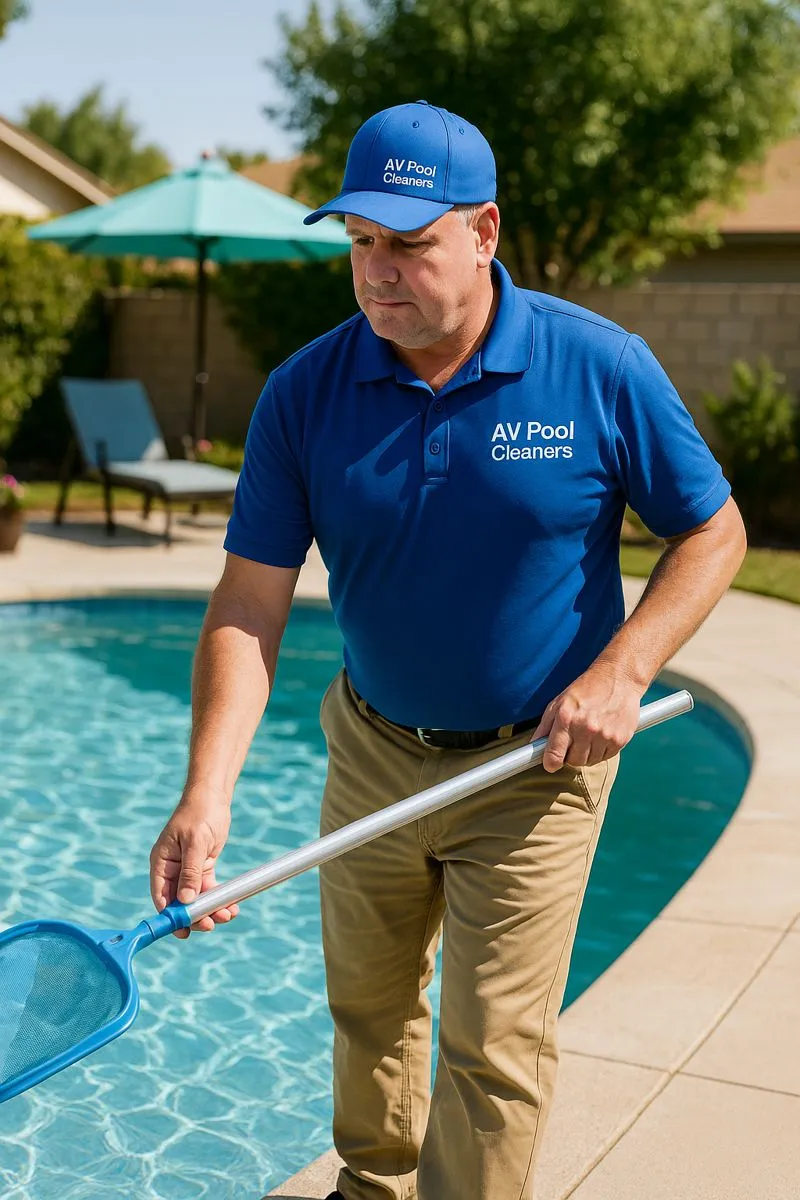
Keeping a pool clean in the Antelope Valley is not the same as maintaining one in a coastal or humid market. Here, the combination of intense summer sun, dry air, Santa Ana-style wind events, airborne dust, and mineral-heavy fill water creates a uniquely demanding environment. Whether your home sits near Rancho Vista in Palmdale, around Quartz Hill, close to Lancaster’s newer subdivisions, or along older neighborhoods near Sierra Highway, pool care has to account for local conditions that can change water balance fast.
AV Pool Cleaners focuses on the everyday realities that matter most to local pool owners: evaporation, calcium scaling, debris intrusion, circulation problems, and the chemistry swings that happen when temperatures climb and water levels drop. A pool may look clean on the surface while still losing sanitizer efficiency, collecting fine dust in corners, or developing rough scale on tile and equipment. A true pool care routine is not just about appearance; it is about protecting water quality, equipment life, and swimmer comfort.
The high-desert climate changes how pools behave. Summer heat accelerates chlorine loss, while windy afternoons blow grit, leaves, and pollen into the water. In neighborhoods near the Antelope Valley Mall, along Avenue S, or off Pearblossom Highway, many homeowners also deal with suspended dust that does not settle quickly. That means skimming alone is not enough. Fine particles often require filtration support, brushing, and proper circulation to remove completely.
Another major issue is mineral content. Hard water and frequent top-offs from evaporation can cause calcium to build up on tile lines, inside heaters, and within salt systems. When water evaporates in this dry climate, the dissolved minerals stay behind. Over time, that creates scale, cloudy water, and a higher chance of equipment inefficiency. If a pool is not watched closely, a simple seasonal issue can turn into a costly repair.
In dry inland climates, pool care is less about reacting to problems and more about preventing them with disciplined weekly habits. The pools that stay clear through the hottest months are usually the ones with the most consistent brushing, testing, and circulation.
Balanced chemistry is the foundation of every healthy pool. Sanitizer levels must stay strong enough to control algae and bacteria, but not so aggressive that they damage surfaces or make the water uncomfortable. pH matters too, because even a small shift can reduce sanitizer performance and encourage scale formation. In the Antelope Valley, where heat and evaporation are constant, chemistry can drift quickly between visits.
Water that does not move does not stay clean. Pumps, skimmers, return jets, and filters all work together to keep debris suspended long enough to be captured. Poor circulation often shows up in dead spots, cloudy corners, and algae growth around steps or behind ladders. Homeowners in larger yards near West Palmdale or rural properties on the outskirts of Lancaster may need extra attention to circulation because windblown debris tends to collect in low-flow areas.
Brushing walls, vacuuming the floor, emptying baskets, and skimming the surface are not optional. Desert dust is fine enough to cling to plaster and tile, and organic debris can break down into nutrients that feed algae. Physical cleaning is especially important after windy days, spring pollen surges, or when nearby landscaping sheds leaves and seed pods.
Your filter is the pool’s cleanup crew. Whether your system uses sand, cartridge, or DE filtration, the filter has to be sized, cleaned, and maintained properly to keep up with local debris loads. A filter that is overdue for cleaning will allow fine dust to recirculate, causing hazy water even when chemistry looks fine. If you live near open lots, desert edges, or streets with high wind exposure, filtration demand is even higher.

A dependable weekly routine keeps most local pools stable. For homeowners who want fewer surprises and better water clarity, the following workflow is a strong baseline:
This rhythm is especially important during July and August, when the Antelope Valley often experiences extreme heat that drives evaporation and increases chlorine demand. It is also valuable in shoulder seasons, because warm afternoons followed by cool evenings can create conditions that make pool chemistry less predictable than many homeowners expect.
| Local Condition | Common Pool Impact | What to Do |
|---|---|---|
| High desert heat | Fast chlorine loss and evaporation | Test frequently and maintain proper water level |
| Wind and dust | Cloudy water, dirty baskets, gritty surfaces | Skim, brush, and vacuum more often |
| Hard water top-offs | Calcium scaling on tile and equipment | Monitor calcium hardness and clean scale early |
| Intense sun exposure | Sanitizer breakdown and warm water | Keep chemicals balanced and circulation strong |
For many homes near the 14 Freeway corridor, where sun exposure can be intense and backyards often have little shade, water temperature can rise quickly. Warm water is more inviting for swimmers, but it also shortens the window in which sanitizer remains effective. That is why small chemistry adjustments matter so much here. A pool that is ignored for even a few days can shift from clear to problematic.
Guessing is one of the fastest ways to create imbalance. Too much chlorine, incorrectly adjusted pH, or random shock treatments can cause irritation, cloudiness, or staining. A reliable test routine prevents overcorrection.
By the time a pool looks hazy, the filter has often been struggling for some time. In dusty neighborhoods or homes with heavy landscape runoff, frequent filter attention is essential.
Low water can damage skimmers, reduce circulation, and make pumps work harder. In the Antelope Valley, evaporation can lower water levels faster than many homeowners realize, especially during peak summer.
Dust, algae spores, and mineral residue often start in places that are not obvious at first glance. Steps, shaded walls, and tile lines need regular attention even when the water appears clear.
For homeowners who want authoritative guidance on pool water safety and sanitation, the U.S. Environmental Protection Agency provides useful background on water quality best practices at EPA.
Good maintenance does more than keep a pool pretty. It helps prevent equipment failure. A neglected pool can strain pumps, clog filters, shorten heater life, and damage salt systems. Scale buildup on heaters is especially problematic because it reduces efficiency and can eventually lead to expensive replacement. Meanwhile, prolonged algae exposure can stain plaster and roughen finishes, making future cleaning more difficult.
In neighborhoods with mature landscaping, such as parts of Quartz Hill or older sections of Lancaster with established trees, the pool may also collect more organic debris than newer homes on open lots. That debris decomposes in the water and increases demand on chlorine. If the pool is not brushed and filtered properly, water can become dull even when the surface appears free of leaves.
Spring is the time to reset after cooler months. Check filter condition, inspect equipment, balance water, and remove any buildup that formed during lower-use periods. Dust and pollen often increase as temperatures rise, so this is a good time to tighten up the cleaning schedule.
Summer is the most demanding season. Expect higher evaporation, faster chemical loss, and heavier swimmer load. Pools in sun-exposed yards need the most attention here, especially when temperatures remain elevated for several consecutive days.
Fall brings more windblown debris and shifting temperatures. The pool may not need the same chemical intensity as midsummer, but circulation and cleaning are still critical to prevent buildup.
Even though use may decline, pools still need monitoring. Cooler nights can affect balance, and debris still enters the water during windy spells. In the Antelope Valley, winter does not mean maintenance stops; it simply changes pace.
Many pool tasks are manageable for homeowners with the right tools and routine, including skimming, basket cleaning, basic brushing, and simple visual inspections. But when water stays cloudy, algae returns quickly, the filter pressure climbs too fast, or scaling becomes visible on tile and equipment, professional help can save time and money.
Local service matters because a technician who works pools in the Antelope Valley every week understands the region’s patterns: the way dust storms affect cartridge filters, how hard water leaves residue on surfaces, and how quickly summer heat can outpace a casual maintenance routine. That local experience is what turns generic advice into real results.
Most pools here benefit from weekly service, with extra attention after windy days or during extreme heat. Some properties may need more frequent skimming and basket cleaning depending on exposure.
Heat, evaporation, and strong sunlight can reduce sanitizer effectiveness quickly. Add dust and increased swimmer use, and water quality can change rapidly without consistent maintenance.
Yes. Hard water can contribute to scale on tile, heaters, and salt systems, especially when evaporation forces homeowners to top off water often.
There is no single task that matters most, but consistent testing, circulation, brushing, and filtration form the foundation of a healthy pool.
A robot can help with debris removal, but it cannot replace chemistry management, filter maintenance, or full system inspection. It is one tool within a complete care routine.
For homeowners looking for a smarter way to protect their pool investment, the best strategy is simple: stay consistent, adapt to local weather, and treat maintenance as prevention rather than reaction. In the Antelope Valley, that approach keeps water clearer, equipment healthier, and swimming more enjoyable all year long.
Skip the DIY guesswork. Get reliable weekly cleaning, water balancing, and equipment checks.